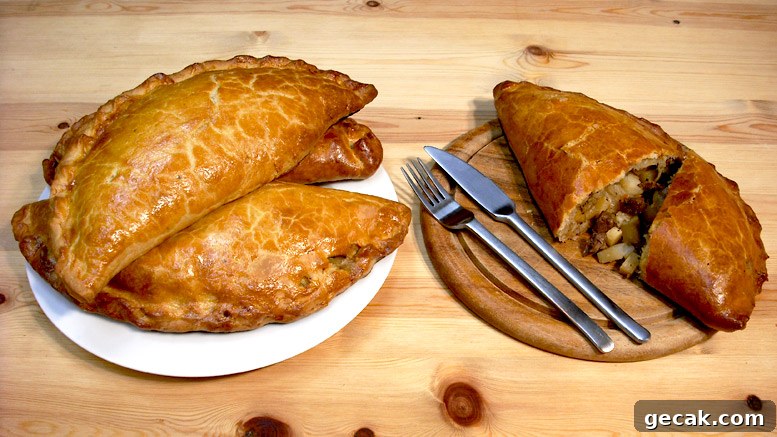
Traditional Cornish Pasties
This traditional Cornish pasty recipe has been made across Cornwall for generations. While the exact origin is uncertain, it’s widely accepted that the pasty’s modern form developed in Cornwall as a portable, complete meal for tin miners. Wives prepared these pastry parcels so miners could carry a filling that stayed warm and could be eaten in the dark of the mine: the thick folded crust served as a handle and was discarded after eating because it had been gripped by dirty hands.
Baking notes: Cornish pasties rely on quality seasoning and well-made pastry. When you follow the steps carefully—the pastry technique and seasoning—the difference is dramatic. You may find store-bought pasties disappointing afterwards. Do not skip boiling the lard, butter and liquid for the pastry; incorporating them cold will not produce the same texture. Grind whole black peppercorns with sea salt in a pestle and mortar so the seasoning is distributed as pleasant bursts throughout the filling instead of clumping. If you plan to serve pasties warm, use the indicated seasoning; if serving cold, consider a little extra salt and pepper.
Traditional Cornish Pasty Recipe
Makes 4 very large pasties; cut in half and served with salad they will easily feed 8.
Recipe Ingredients
Pastry:
- 850 g plain flour
- 4 egg yolks
- 140 g lard, diced
- 140 g butter
- 200 ml water
- 200 ml milk
- 1/2 tsp sea salt
- 1/2 tsp freshly ground black pepper
- 2 egg yolks, beaten, for glaze
Pasty filling:
- 400 g waxy potatoes (for example Desiree)
- 1/2 swede (about 400 g)
- 1 large onion, peeled and chopped
- 400 g rump beef
- 2 tsp sea salt
- 2 tsp whole black peppercorns, freshly ground
- 40 g butter, diced
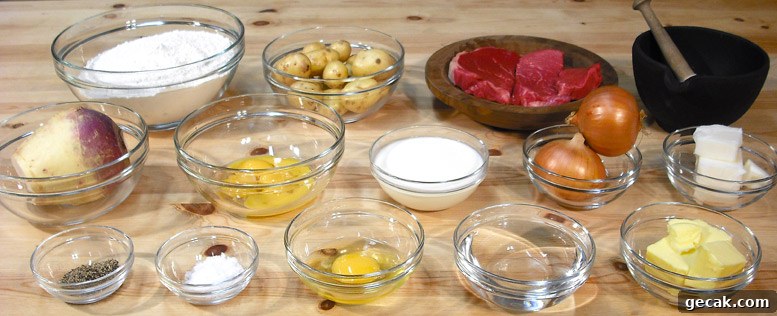
Ingredients For A Traditional Cornish Pasty
Recipe Method
Note: The pastry is easiest to handle if made a few hours or the day before and chilled, then brought back to room temperature before rolling.
The pastry:
Sift the flour into a mixing bowl, sprinkle in the 1/2 tsp sea salt and the freshly ground black pepper. Make a well in the centre and add the egg yolks.
Gently heat the lard and butter with the milk and water until the fats have melted, then bring quickly to the boil. Pour the hot liquid into the flour well and draw the ingredients together with a wooden spoon to form a soft, pliable dough that is not overly sticky. Add a little water if too dry or a little flour if too wet.
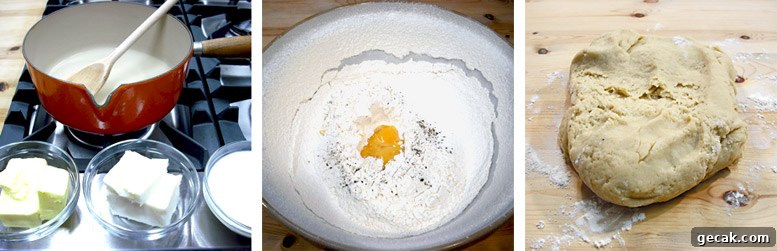
Making The Pastry For The Cornish Pasties
Turn the dough out onto a lightly floured surface and knead gently until smooth and elastic—this is a light knead, not as vigorous as bread dough, just enough to distribute the ingredients evenly. Cover and rest in a warm place for 20–30 minutes, then chill in the fridge for at least two hours; overnight is preferable.
The filling:
Grind the whole black peppercorns to a coarse grain in a pestle and mortar, then add the sea salt and combine. Peel the potatoes, swede and onion, and cut into roughly 1 cm dice. Cut the beef into similar-sized pieces and season with a pinch of the freshly ground salt and pepper.
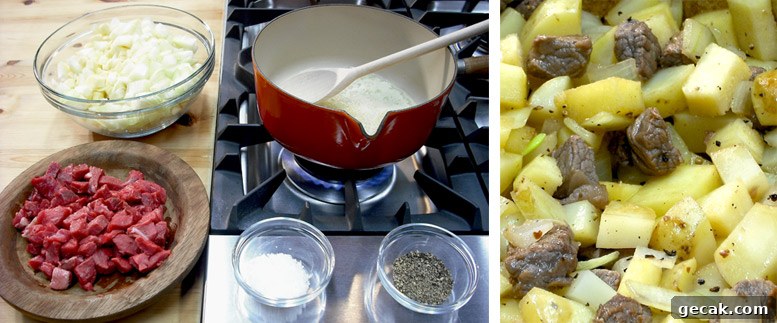
Frying Off The Filling For The Cornish Pasties
Heat half the butter in a wide frying pan over medium-high heat. Sear the beef in batches for 1–2 minutes until browned all over, then transfer to a plate and reserve. Add the remaining butter to the pan and fry the diced vegetables for about 5 minutes until softened and the onion begins to turn golden. Pour any juices from the resting beef back into the pan, add the remaining sea salt and black pepper, and cook for a further 2 minutes. Return the beef to the pan, mix well, then remove from the heat and allow the filling to cool. Ensure the seasoning is evenly distributed.
Assembling and baking:
Preheat the oven to 220°C (425°F).
Divide the pastry into four portions. Roll each portion on a lightly floured surface to a circle about 4 mm thick, trimming neatly—use a dinner plate as a guide if helpful. Divide the cooled filling among the pastry circles, placing it on one half of each circle and leaving a 2 cm border around the edge.
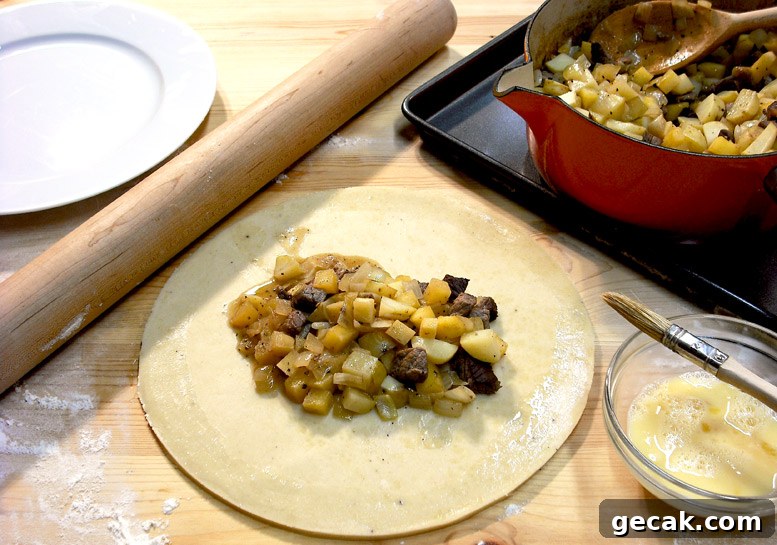
Putting The Cornish Pasties Together For Baking
Brush the pastry edges with a little beaten egg, fold the pastry over the filling to form a semicircle, then crimp and roll the edges to seal completely so no filling can leak during baking. Transfer the pasties to a large baking sheet and brush the tops with the remaining beaten egg.
Bake at 220°C for 10 minutes, then reduce the oven temperature to 190°C (375°F) and bake for a further 30–35 minutes. If the pastry browns too quickly, cover loosely with greaseproof paper. Remove from the oven and allow to cool slightly; pasties are delicious served warm or at room temperature.